 Mahabub
Decision
Task-first operational UI
Reason
Staff success is measured in speed and accuracy, not novelty.
Trade-off
Less decorative polish than customer-facing marketing sites.
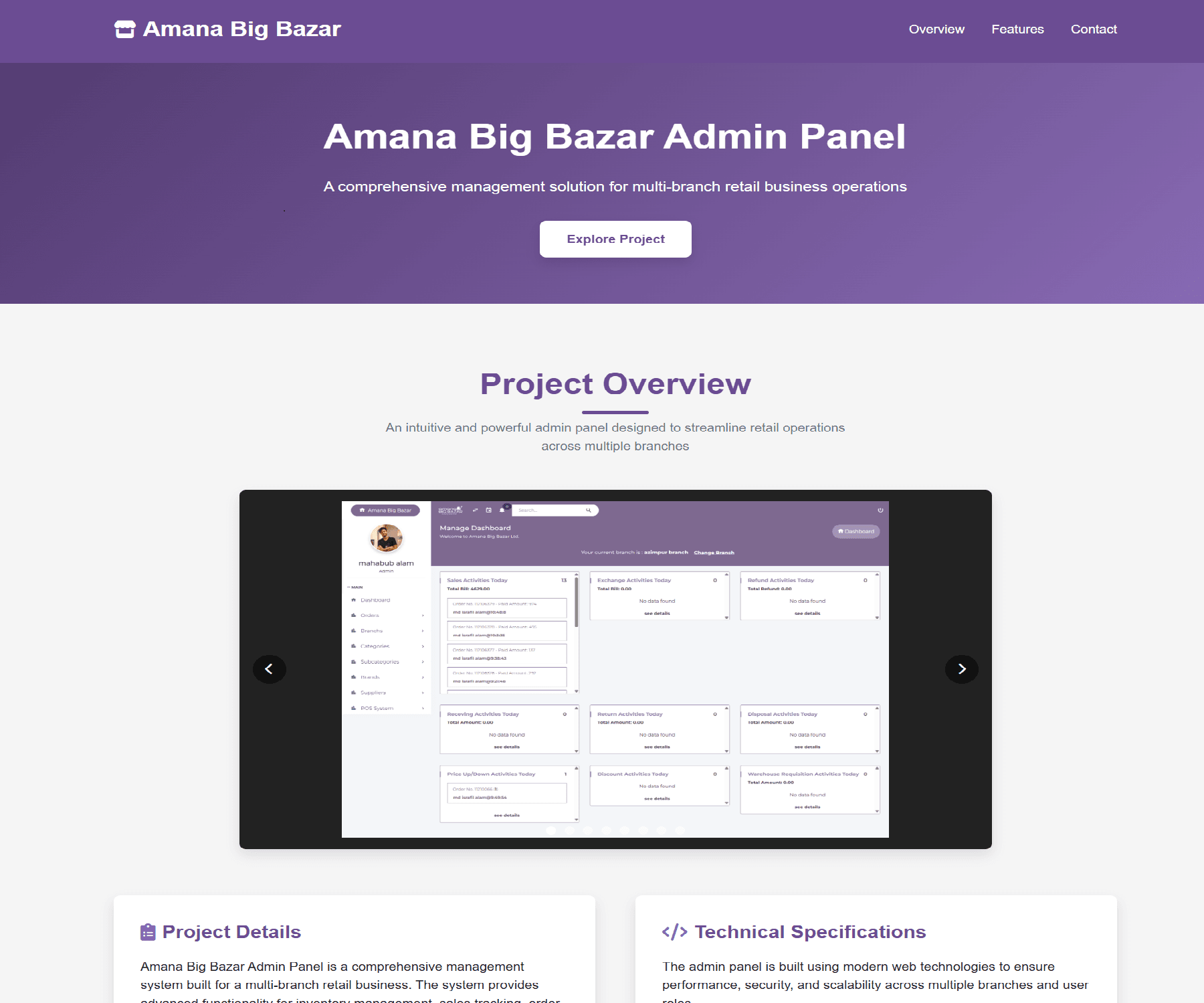
An internal-facing retail system focused on accuracy and speed — helping teams manage transactions, stock, and reporting from one operational surface.
Case narrative
The Amana POS System consolidates sales, inventory, and reporting into an operational tool built for daily accuracy.
Problem
Disconnected workflows create delays and errors when staff move between sales, stock, and reporting contexts.
Why it was difficult
Operational UI must stay dense enough to be useful and calm enough to prevent mistakes under pressure.
Approach
I contributed full-stack admin/POS surfaces oriented around real staff tasks, backed by Express services and MongoDB records.
Why this approach
Task completion beats visual spectacle in internal tools — architecture and UI should follow the work, not a marketing template.
Outcome
A practical operational interface that supports retail day-to-day work with clearer ownership of sales and inventory concerns.
What I learned
Internal tools succeed when every click saves time Operational clarity beats decorative UI Cross-team collaboration improves real-world fit
Trade-offs
Choices that shaped the architecture — including what we accepted in return.
Decision
Reason
Staff success is measured in speed and accuracy, not novelty.
Trade-off
Less decorative polish than customer-facing marketing sites.
Decision
Reason
Flexible documents fit evolving retail workflows.
Trade-off
Requires careful schema discipline for reporting consistency.
Decision
Reason
Mirrors how teams already think about the work.
Trade-off
Shared navigation and permissions need ongoing coordination.
System shape
Visuals
A product screenshot from this project. Select it to open a larger view.
Outcome
Practical results across experience, maintainability, scale, and value — without invented metrics.
Staff workflows stay closer to one coherent operational surface.
Modular views make it easier to extend sales, stock, or reporting without entanglement.
API + document storage support evolving retail process needs.
Better operational clarity reduces friction in daily retail execution.
Open the deployment, or continue to another case study below.