 Mahabub
Decision
Category-first browsing model
Reason
Customers already think in categories — match mental models first.
Trade-off
Requires careful taxonomy work to avoid dead-end paths.
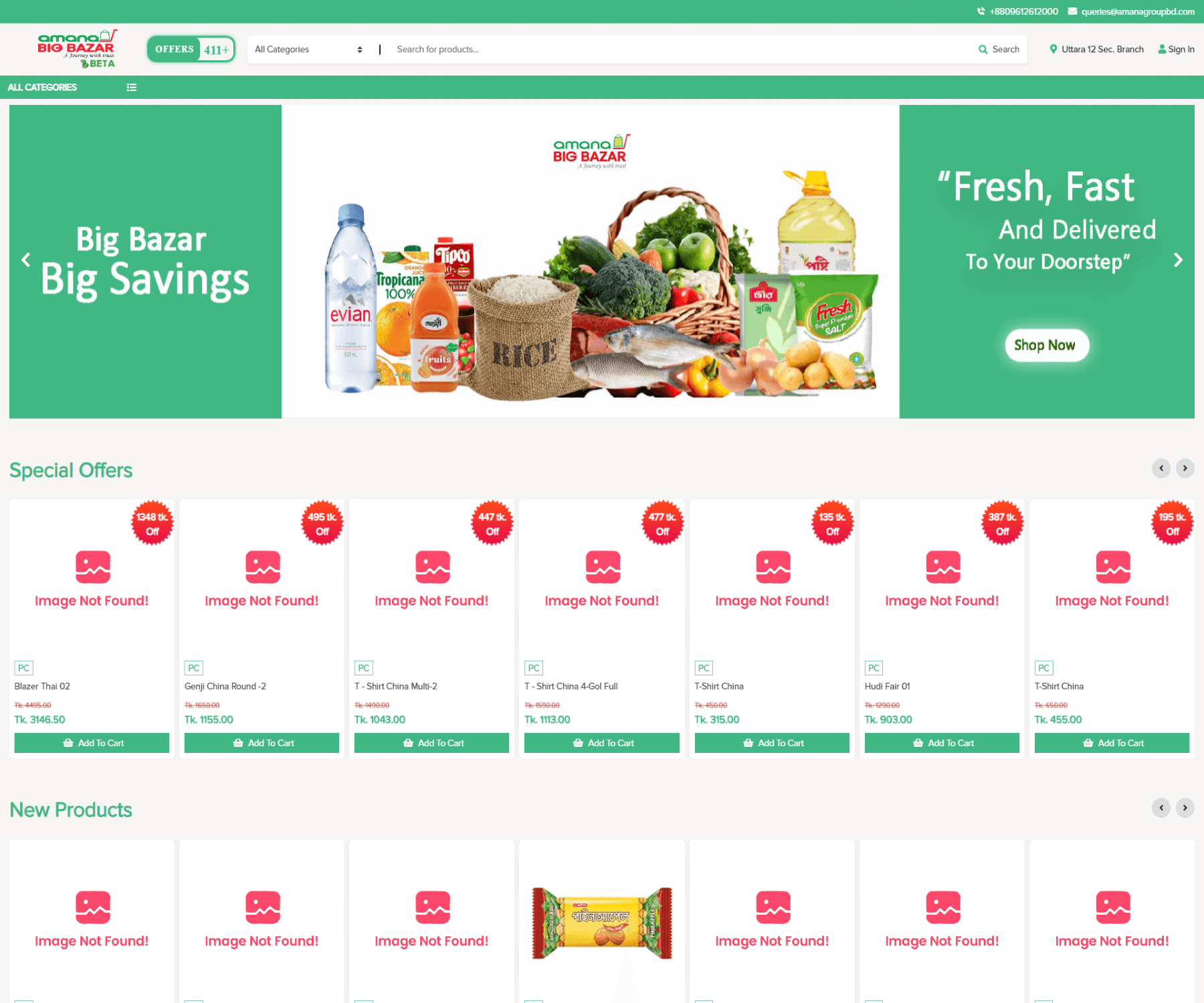
A commerce experience built for real catalog browsing — search, filters, cart flow, and delivery-oriented journeys that support everyday retail operations.
Case narrative
Amana Big Bazar needed a storefront that could handle everyday retail browsing — categories, search, cart, and delivery-oriented journeys.
Problem
Without strong navigation and a dependable cart path, catalogs become unusable and purchase intent drops.
Why it was difficult
Commerce UI fails first at information architecture: finding products, trusting the cart, and understanding next steps.
Approach
I helped deliver a Vue storefront with Express-backed commerce workflows, focusing on category clarity and practical purchase flows.
Why this approach
Separating storefront concerns from API responsibilities kept browsing UX iterative while backend operations stayed flexible.
Outcome
A production e-commerce experience oriented around real shopping behavior rather than decorative catalog pages.
What I learned
Commerce UX fails first at navigation, not checkout polish Reusable components reduce inconsistency across catalog pages Backend clarity makes storefront iteration safer
Trade-offs
Choices that shaped the architecture — including what we accepted in return.
Decision
Reason
Customers already think in categories — match mental models first.
Trade-off
Requires careful taxonomy work to avoid dead-end paths.
Decision
Reason
Allowed independent iteration of UI and operational data flows.
Trade-off
Needs clear contracts between client and services.
Decision
Reason
Everyday shopping behavior is heavily mobile.
Trade-off
Desktop density is intentionally simpler than a dense admin grid.
System shape
Visuals
A product screenshot from this project. Select it to open a larger view.
Outcome
Practical results across experience, maintainability, scale, and value — without invented metrics.
Shoppers can browse by category and move through cart-oriented steps with less confusion.
Shared commerce components reduce duplicated storefront patterns.
API separation supports catalog growth without rewriting the client shell.
A usable digital storefront for everyday retail discovery and purchase intent.
Open the deployment, or continue to another case study below.