 Mahabub
Decision
Next.js App-style composition
Reason
Needed SEO-ready pages and reusable section patterns for content growth.
Trade-off
Slightly more framework structure than a static marketing site.
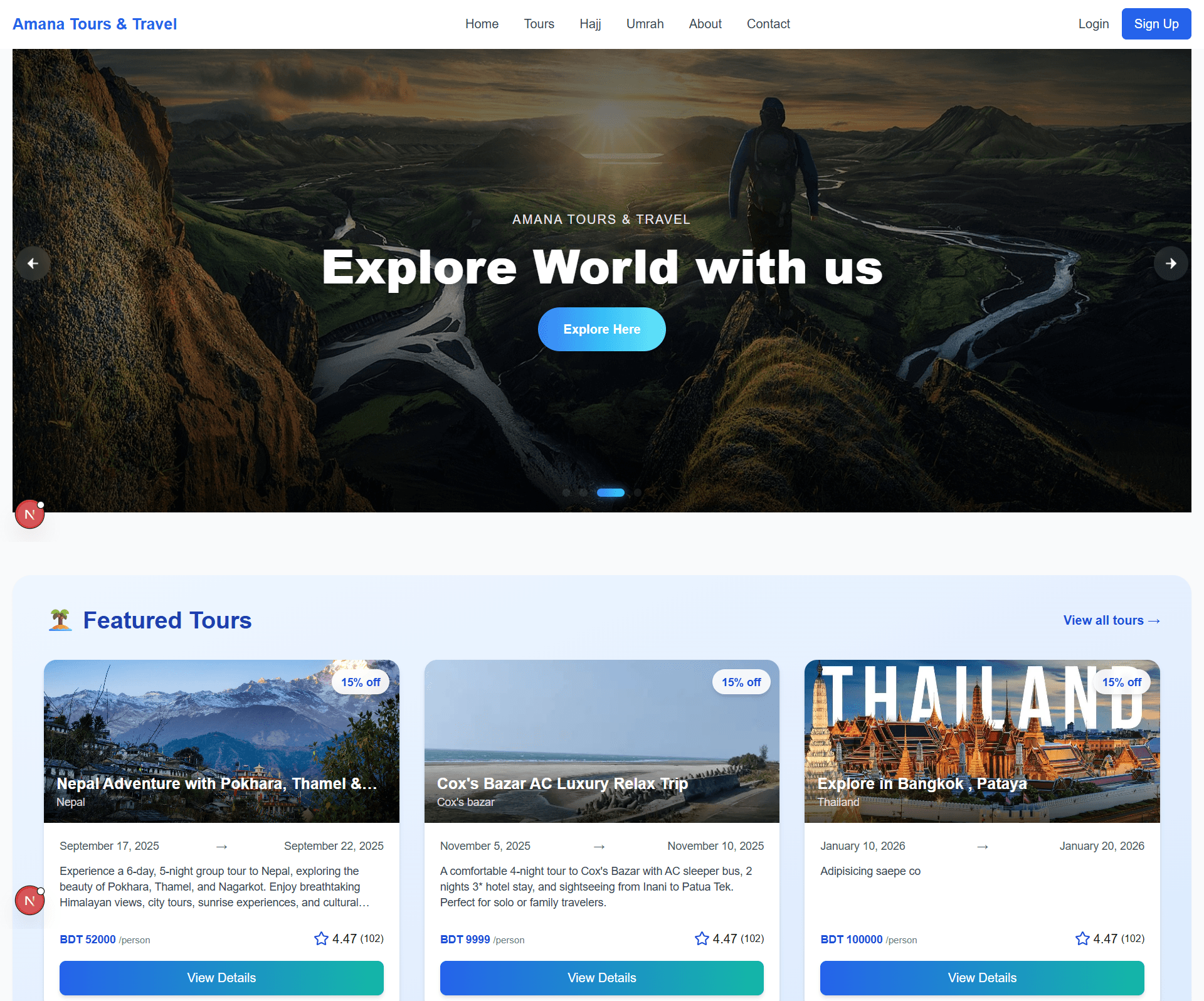
A production travel product that turns package discovery into confident booking — with clear itineraries, flexible plans, and a stack built for speed and maintainability.
Case narrative
Amana Tours needed a digital product that could earn trust quickly — especially for high-intent travel decisions like Hajj, Umrah, and custom packages.
Problem
Package details were dense and unevenly presented, so visitors struggled to compare options and move toward enquiry with confidence.
Why it was difficult
The hard part was not rendering pages — it was compressing complex travel information into a calm, scannable experience without losing credibility or SEO reach.
Approach
I shaped a Next.js + TypeScript product surface with structured package presentation, enquiry-oriented CTAs, and Express/MongoDB services behind the UI.
Why this approach
Next.js gave us SEO-friendly delivery and maintainable page composition, while a typed full-stack boundary reduced regressions as content and features expanded.
Outcome
The result is a clearer booking-oriented experience that presents packages as products — easier to scan, easier to trust, and easier to evolve.
What I learned
High-intent products need clarity more than decoration Type safety pays off quickly in content-heavy travel flows Reusable sections make marketing updates safer
Trade-offs
Choices that shaped the architecture — including what we accepted in return.
Decision
Reason
Needed SEO-ready pages and reusable section patterns for content growth.
Trade-off
Slightly more framework structure than a static marketing site.
Decision
Reason
Package and enquiry flows change often — type safety reduces silent breakage.
Trade-off
Upfront typing cost for faster long-term iteration.
Decision
Reason
Keeps content/ops concerns out of the presentation layer.
Trade-off
Requires intentional API contracts and deployment coordination.
System shape
Visuals
A product screenshot from this project. Select it to open a larger view.
Outcome
Practical results across experience, maintainability, scale, and value — without invented metrics.
Visitors can compare packages with less friction and a clearer path to enquiry.
Section-based UI and typed boundaries make content and feature updates safer.
The stack supports expanding package types and services without rewriting the shell.
A more trustworthy digital presence for high-consideration travel decisions.
Open the deployment, or continue to another case study below.